
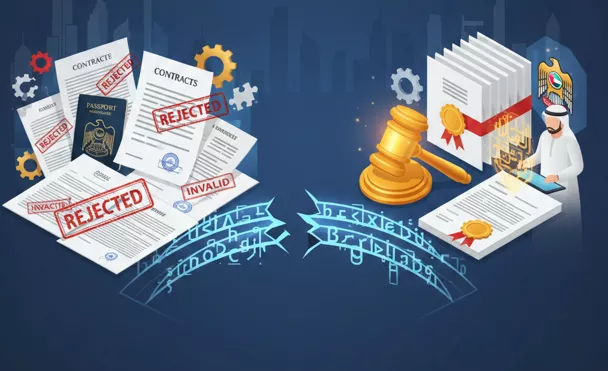
Quick Answer: Legal translations get rejected in Dubai mainly due to a lack of certified translators, non-compliance with UAE court standards, missing legalization, and errors in the legal or cultural context.
Legal translations are more than just word-for-word conversions; they bridge languages and laws, and using professional translation services in Dubai ensures accuracy and legal compliance. In Dubai, even a minor mistake can lead to rejected legal translation in Dubai, causing delays, fines, or invalid contracts. Understanding the common pitfalls and following official legal translation requirements in the UAE is crucial to ensure your documents are accepted by authorities and courts.
Common Reasons Legal Translations Get Rejected in Dubai
1. Lack of Certified Legal Translator Dubai
Dubai authorities require that all legal translations be performed by an approved legal translator in Dubai. Generic translators or online translation tools often miss the specialized legal terminology needed for contracts, agreements, or court rulings. Without certification, your translation risks being rejected, regardless of linguistic accuracy.
Always verify the translator’s official registration with the UAE Ministry of Justice.
2. Non-Compliance with UAE Court Translation Standards
UAE courts have strict rules regarding format, notarization, and submission of translated documents. Failing to follow these standards, even a minor formatting error, can result in rejection. Certified translators are familiar with these requirements and ensure compliance with all UAE court translation standards.
Example: A marriage certificate translated without notarization may be rejected, delaying visa or residency processing.
3. Ignoring Legal and Cultural Nuances
Dubai’s legal system blends civil law with Sharia principles. Translators must understand not only the language but also the legal context and cultural nuances. Misinterpreting clauses or failing to reflect Sharia-specific terms can lead to inaccurate or even offensive translations.
Choose a translator with proven expertise in legal translation in Dubai, familiar with local legal norms.
4. Lack of Proper Certification and Legalization
Even accurate translations can be rejected if they are not certified and legalized. Legal documents must often pass a formal verification process to be officially recognized. Failure to certify documents can invalidate contracts, court submissions, or government filings.
Always ensure your documents are handled by professional legal translation expert in Dubai, including notarization and legalization when required.
5. Over-Reliance on Machine or Generic Translation Tools
Machine translations may save time, but are unsuitable for legal documents. Algorithms cannot understand Dubai’s specific legal terminology or enforce legal translation requirements in the UAE. Using automated services risks rejected legal translation in Dubai, as authorities will not accept uncertified or unverified outputs.
Use a professional Certified Translation Services in Dubai that guarantees accuracy, compliance, and official acceptance.
How to Ensure Your Legal Translation Is Accepted
- Hire approved legal translators in Dubai with experience in your document type.
- Verify that translations comply with UAE court translation standards.
- Ensure all documents are certified, legalized, and notarized.
- Avoid generic or machine translations for contracts, court rulings, and official documents.
- Keep translations culturally and legally accurate, especially for Sharia-based content.
Conclusion
Rejected legal translations in Dubai can lead to serious consequences, from legal disputes to financial loss. By using certified legal translation Dubai services, adhering to UAE legal requirements, and choosing experienced translators, you ensure your documents are accurate, compliant, and accepted by authorities.
Protect your legal interests and maintain credibility by understanding the importance of legal translation in Dubai’s unique legal and cultural landscape. When it comes to legal translations in Dubai, precision, expertise, and certification are non-negotiable.
Choose the Rightway Translation in Dubai for Reliable Legal Translations
For professional legal translations that meet Dubai’s standards, rely on Rightway Translation in Dubai.
- UAE Ministry of Justice-approved translators
- Expertise in Dubai’s legal system and Sharia-compliant documents
- Full compliance with court standards and notarization
- Confidential and timely service