
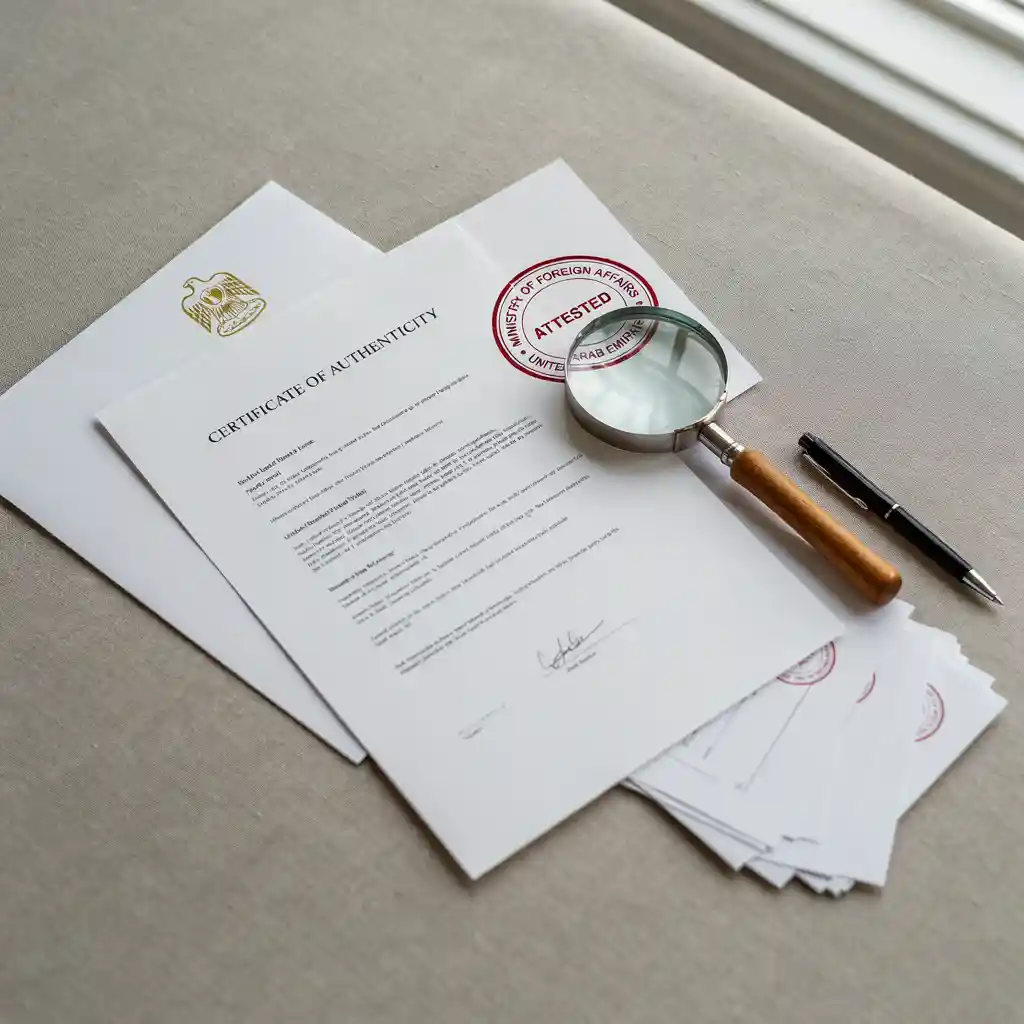
A document can look completely genuine at first glance. The stamp is there. The signature appears official. There may even be a QR code in the corner.
But when that document is submitted for a UAE visa, employment process, university application, court matter or government transaction, one question matters more than how professional it looks:
Can the attestation actually be verified?
This is where people often make the wrong check.
From our experience working with official documents at Right Way Translation, we have found that people naturally focus on the appearance of a stamp. We prefer to start with the authority behind it. A genuine-looking seal is only a visual feature; confirmation from an official verification source carries far more weight.
If you have been searching for how to check UAE attestation original or fake, this guide walks you through the process step by step.
For documents where a verified copy of the original is required rather than full legalization, our True Copy Attestation Services in Dubai can also help you understand which type of certification is suitable for the intended use.
The Quickest Way to Check UAE Attestation
For eligible digitally attested documents, the safest starting point is an official UAE government verification channel.
The UAE Ministry of Foreign Affairs provides MOFA Verify, which is designed to verify the authenticity, integrity and validity of supported Digital Trusted Documents. MOFA’s document attestation service also points users to its digital document verification system.
The UAE Government also operates UAE Verify, a platform intended to confirm the authenticity of supported digital documents issued by participating entities.
So the basic rule is simple:
Do not decide that an attestation is genuine simply because its stamp looks correct. Verify the digital record or issuing authority whenever that option is available.
What Does an “Original UAE Attestation” Actually Mean?
Attestation is the process used to authenticate signatures and seals on official documents so that they can be accepted for their intended official purpose. UAE MOFA describes attestation as certification of the authenticity of signatures and seals on documents issued inside or outside the UAE.
That means there are two separate things to think about:
The document itself may be genuine.
The attestation placed on that document must also be genuine.
For example, a person might have a completely legitimate university degree, but that does not automatically prove that every legalization stamp later added to the certificate is authentic.
This is why proper verification matters.
Step 1: Identify Which Authority Attested the Document
Before scanning codes or comparing stamps, identify what type of attestation you are looking at.
Ask:
- Was the document attested by UAE MOFA?
- Was it attested by a UAE embassy or consulate abroad?
- Was it first authenticated by the foreign ministry in the country where it was issued?
- Is it a notarized or certified true copy rather than a MOFA-attested original?
- Is it a digitally issued document?
These distinctions matter because there is no single visual test that applies to every certificate.
For documents issued outside the UAE, MOFA states that the original generally needs authentication from the foreign affairs authority in the issuing country, followed by the relevant UAE embassy or consulate and UAE attestation procedures. Requirements can depend on the document and where it was issued.
Understanding that chain gives you something concrete to verify.
Step 2: Use MOFA Verify for Supported Digital Documents
If the document contains a digital MOFA attestation or is presented as a Digital Trusted Document, use the official MOFA verification platform.
MOFA Verify is specifically designed to confirm whether supported digital documents are authentic, valid and unchanged from the official source.
This is much stronger evidence than examining a downloaded PDF visually.
A fraudulent PDF can imitate:
- a ministry logo,
- an official-looking signature,
- a stamp,
- a reference number,
- or even a QR code.
What is much harder to imitate is a valid record returned by the official verification system.
What should you check after verification?
Confirm that the information shown by the verification system matches the document you received, including:
- document holder’s name,
- document type,
- issuing authority,
- certificate or reference details,
- and any other available verification information.
If the verification result relates to a different document or person, treat that as a serious warning sign.
Step 3: Check the QR Code, Barcode or Reference Number
Modern digital documents may include verification features such as QR codes, barcodes, electronic links or reference numbers. MOFA’s documentation refers to digital verification mechanisms that can include such identifiers.
But there is an important point people often miss:
The presence of a QR code does not by itself prove that a document is genuine.
Anyone can print a QR code.
What matters is where that code takes you and what the official verification system returns.
When scanning a code, check whether it leads to the legitimate government verification environment and whether the information displayed corresponds with your actual document.
Be cautious if the QR code:
- opens an unrelated website,
- goes to a generic file-sharing page,
- displays different personal information,
- produces an error when the document is supposed to be digitally verifiable,
- or simply opens another copy of the same PDF without providing independent verification.
Step 4: Compare Every Important Detail
A common document problem is not an obviously fake stamp. It is inconsistent information.
Compare the verification record with the document carefully.
Look at:
- full name and spelling,
- passport or identification details where applicable,
- university or institution name,
- qualification title,
- date of issue,
- certificate number,
- issuing country,
- page count,
- reference numbers,
- and dates shown beside attestations.
Even a small mismatch deserves investigation before the document is submitted.
We have learned through document-handling work that this detail-by-detail review is far more useful than simply asking, “Does the stamp look real?”
Step 5: Check the Attestation Chain
This step is especially important for foreign-issued certificates.
Imagine someone brings a degree issued outside the UAE for an employment application. The final UAE attestation may be only one part of the document’s legalization journey.
For many foreign-issued documents, the process involves authentication in the country of origin before the UAE mission and MOFA stages are completed. MOFA’s current guidance explains this sequence for documents issued abroad.
If one stage is missing, that does not automatically mean the remaining stamps are fake. It may simply mean that the attestation process is incomplete.
That distinction is important.
Fake attestation and incomplete attestation are not the same problem.
If you are unsure what sequence your document should follow, our guide to document attestation requirements in the UAE explains the broader process before you proceed with submission.
Step 6: Verify the Issuing Authority When Necessary
Not every document can be judged through one UAE portal.
If the questionable authentication came from:
- a foreign ministry outside the UAE,
- a university,
- an overseas notary,
- a foreign embassy,
- or another issuing body,
you may also need to verify that stage with the authority responsible for it.
This becomes especially important with older physical documents that were issued before current digital verification systems became common.
If you cannot verify a historic stamp online, do not automatically label the document fake.
Instead, contact the issuing or attesting authority using independently obtained official contact details.
Step 7: Look for Physical Warning Signs
Visual inspection can still help, but it should be treated as a screening method rather than final proof.
Potential warning signs include:
- misspelled government authority names,
- inconsistent logos,
- blurry or obviously reproduced seals,
- different names on different pages,
- unexplained alterations,
- dates that do not make chronological sense,
- missing pages,
- reference numbers that do not match accompanying records,
- poor-quality edits around stamps or signatures,
- or verification codes leading to unrelated destinations.
However, an older authentic certificate may look very different from a newly issued digital document.
That is why appearance alone should never be your only test.
Step 8: Understand the Difference Between True Copy and Full Attestation
Another problem we regularly encounter is confusion between certified true copy attestation and document legalization.
They are related document-certification services, but they do not necessarily serve the same purpose.
A certified true copy generally confirms that a copy accurately corresponds to the original document presented for certification. Full attestation may instead involve authentication through one or more official authorities depending on where the document was issued and where it will be used.
Right Way Translation’s Dubai true-copy service handles legal, academic, corporate and personal documents where properly certified copies are required.
For people or businesses handling documents locally in Sharjah, our true copy attestation services in Sharjah can help determine whether the receiving authority requires a certified copy, further legalization or another form of authentication.
The important lesson is: do not assume every document needs the same type of stamp.
Always check what the receiving authority actually requires.
Step 9: Do Not Trust a Screenshot as Proof
This is particularly important when documents are being shared through WhatsApp, email or recruitment channels.
A screenshot of a verification page is not the same as performing the verification yourself.
Screenshots can be:
- edited,
- outdated,
- taken from another person’s document,
- or cropped to hide important details.
Whenever possible, verify the actual document independently using the official system rather than relying on an image sent by another person.
Common Signs That an Attestation Needs Further Verification
You should investigate further when:
- The QR code does not produce a valid official result.
- The verified record shows a different person or document.
- Names or certificate numbers do not match.
- The legalization sequence appears incomplete.
- The supposed issuing authority cannot confirm the record.
- Parts of the PDF appear digitally altered.
- A person refuses to provide the original or verifiable digital document without a reasonable explanation.
- The document is being rushed through an unofficial agent who discourages independent verification.
None of these points alone should be used to accuse someone of fraud. They are reasons to stop and verify before relying on the document.
Why Fake Attestation Can Become a Serious Problem
An attested document is often used for something important.
Examples include:
- employment and professional licensing,
- residence and family visa applications,
- academic admission,
- degree recognition,
- marriage and birth documentation,
- corporate matters,
- legal proceedings,
- immigration files,
- and embassy submissions.
Submitting a questionable document can lead to rejection, delays or further scrutiny.
The safest approach is to discover the issue before the document reaches the receiving authority.
Can You Verify an Old UAE Attestation Online?
Sometimes yes, sometimes not.
Current UAE systems provide digital verification for supported electronic documents, but an older paper attestation may not necessarily work through the same digital process used for newly issued documents. The correct verification route depends on the authority, document format and period in which the attestation was completed.
If an older certificate cannot be found digitally, contact the relevant authority instead of assuming it is fraudulent.
What Should You Do If You Think the Attestation Is Fake?
First, avoid submitting the document until its status is clarified.
Then:
- Keep the original file or physical document unchanged.
- Perform official digital verification where available.
- Check all names, dates and reference numbers.
- Identify every authority involved in the legalization chain.
- Contact the relevant authority if verification is inconclusive.
- Ask an experienced document-attestation professional to review the required process.
- If the document was supplied by a third party, request evidence showing where and how it was attested.
Do not try to “correct” or replace suspicious seals yourself. If a genuine attestation is missing, the correct solution is to complete the legitimate procedure through the appropriate authority.
A Practical Rule We Recommend
When clients ask us how they can recognize a real UAE attestation, we give them one simple principle:
Verify the record, not just the stamp.
A neat stamp can be copied.
A logo can be reproduced.
A PDF can be edited.
A QR code can be printed.
But when an official government verification system confirms the document and the verified information matches what is in front of you, you have much stronger evidence of authenticity.
MOFA Verify exists specifically to verify the authenticity, integrity and validity of supported Digital Trusted Documents.
That should always carry more weight than appearance alone.
Frequently Asked Questions
How do I check if my UAE MOFA attestation is genuine?
For a supported digital attestation, use the official MOFA digital verification service and compare the verification result with the information on your document. MOFA currently provides Digital Document Verification as part of its attestation ecosystem.
Can I verify UAE attestation using a QR code?
If the document contains a verification QR code, you can scan it, but check the destination and verification result carefully. A QR code by itself is not proof of authenticity.
How can I check MOFA attestation online?
Supported Digital Trusted Documents can be checked through MOFA Verify. MOFA also provides document-verification options through its official digital services.
What if my UAE attestation has no QR code?
A missing QR code does not automatically mean the attestation is fake. Older or differently processed documents may use other verification methods. Identify the authority and document type and confirm through the appropriate official channel.
Can a fake attestation stamp look real?
Yes. Visual appearance alone cannot reliably establish authenticity. Digital or authority-level verification is therefore more dependable than judging the stamp’s design.
Is True Copy Attestation the same as MOFA attestation?
No. A certified true copy generally confirms that a copy corresponds to an original presented for certification, whereas MOFA attestation authenticates signatures and seals as part of the official attestation process. The exact certification needed depends on the receiving authority and intended use.
What should I do if online verification fails?
Check that you are using the correct verification system and that the document is eligible for digital verification. If the result remains unclear, contact the authority responsible for the attestation rather than concluding immediately that the document is fake.
Final Thoughts
Knowing how to check UAE attestation original or fake can save you from discovering a document problem at the final stage of a visa, employment, education or legal process.
Start by identifying who attested the document. Then use official digital verification where available, confirm QR codes or reference information, compare every document detail and review the complete attestation chain.
Most importantly, do not use appearance as your final test.
At Right Way Translation, we believe important documents should be checked before they are submitted, not after they are rejected. With more than 20 years of experience providing translation, attestation and related document support in the UAE, our team helps individuals and businesses understand the correct certification route for their documents. Right Way Translation states that it has operated since 2004 and provides translation and attestation support across the UAE.
When the authenticity or certification route of a document is unclear, professional review can help you identify what should be verified and what additional attestation, translation or certification may actually be required.