
A single word almost cost a client a business.
A few years ago, a French investor sent us a share purchase agreement that another provider had already “translated.” It looked clean. The grammar was perfect. But one line described an arbitral sentence instead of an arbitral award. In English, a “sentence” is a punishment handed down in a criminal case. The document now read as if a business dispute could send someone to prison. Dubai Courts flagged it. The filing was delayed for weeks, and the deal nearly collapsed over one mistranslated term.
That is the hard truth about legal translation: it is not about swapping words. It is about carrying legal meaning across two very different systems without dropping anything. This is exactly why French legal translation in Dubai demands a specialist, not a bilingual friend or a free app.
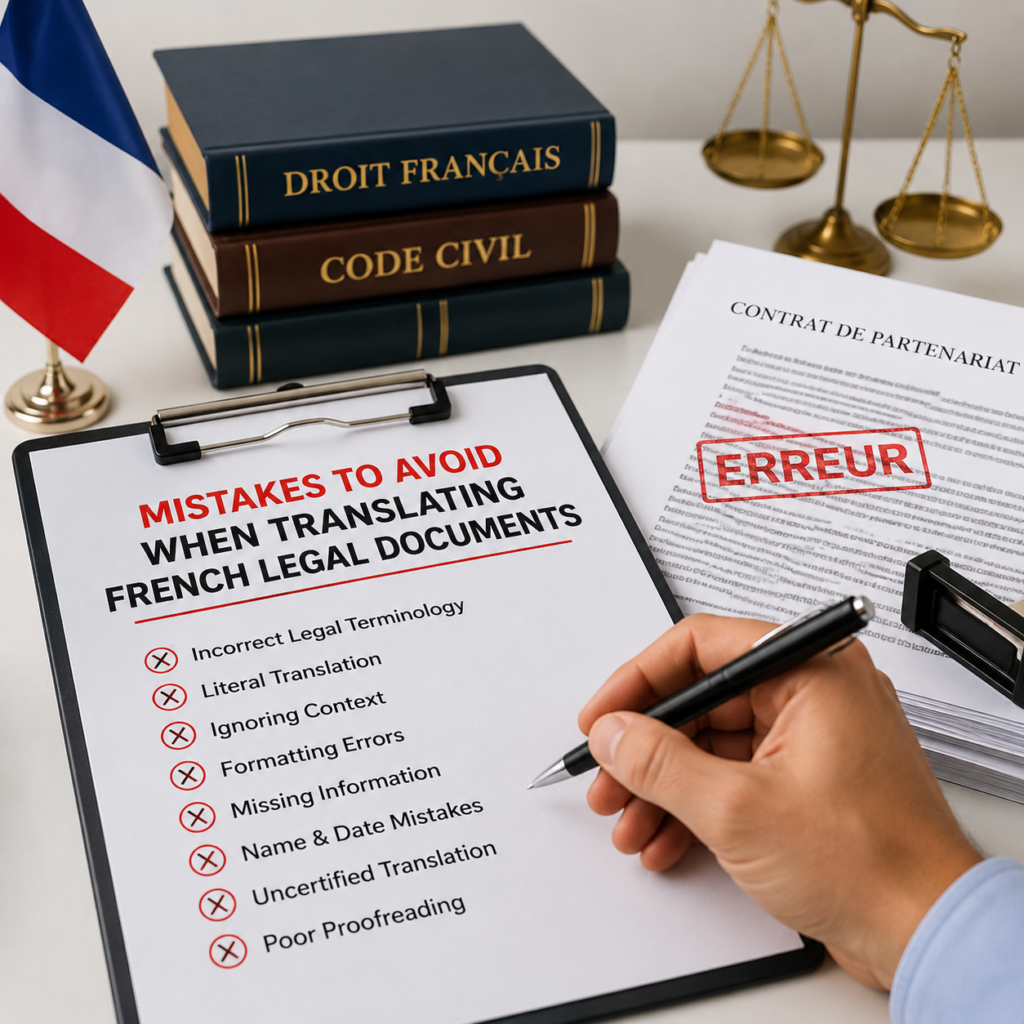
Below are the seven mistakes we see most often, why each one is dangerous, and how to avoid them.
Why French Legal Translation Is So Easy to Get Wrong
French and English law grew from different roots. French law follows the civil law tradition. It relies on written codes like the Code civil and the Code pénal, and it traces back to Roman law. English-speaking countries mostly follow common law, which leans on court decisions and precedent.
Because the systems differ, many legal ideas do not line up one-to-one. A term can look familiar and still mean something completely different. So the translator must understand both legal systems, not just both languages. Miss that, and the errors below start to appear.
Mistake 1: Trusting “False Friends” (Faux Amis)
French and English share thousands of similar-looking words. In law, many of them are traps. Translators call these faux amis, or false friends. They look like a match but carry a different legal meaning.
Here are real examples that trip people up:
- Notaire is not a “notary.” A French notaire is a highly trained public official who drafts and authenticates deeds. An English notary public does far less. Treating them as equal changes the legal weight of a document.
- Magistrat is not a “magistrate.” The roles and rank differ between systems.
- La doctrine does not mean “doctrine.” In French law it means legal scholarship and academic writing.
- Demande is not always a “demand.” It often means a claim or application.
- Sentence arbitrale means an arbitral award, not an “arbitral sentence.”
One wrong choice here can flip the meaning of a clause. A skilled translator knows these traps by heart and checks each one against context.
Mistake 2: Translating Word-for-Word Instead of Meaning
Legal translation is not a word swap. The goal is functional equivalence — producing the same legal effect in the target language, not the same string of words.
A literal, word-for-word approach often reads oddly and, worse, changes the obligation. A clause about liability or a condition might sound close but bind the parties differently. In court, “close enough” is not good enough.
Good translators read the whole sentence, understand the intent, and then rebuild it so a judge or lawyer in the target system reads the exact same duty. That care is what separates a rough draft from real professional legal translation.
Mistake 3: Ignoring the Gap Between Legal Systems
Some legal concepts simply have no twin on the other side.
- The common-law idea of “consideration” in a contract (a bargained-for exchange) has no clean French equivalent.
- The English “trust” is often left untranslated, because the French fiducie does not carry the same meaning outside places like Quebec.
- Common-law terms like “tort” or “estoppel” need careful handling, not a forced French word that misleads the reader.
When no equivalent exists, a strong translator does not guess. They may keep the original term, add a short explanation, or use an accepted rendering that a legal reader will understand. What they never do is invent a false match.
Mistake 4: Using an Unlicensed or Non-Certified Translator
This is the most expensive mistake of all in the UAE.
In the United Arab Emirates, legal translation is regulated. Under Federal Law No. 6 of 2012 and its executive regulation (Cabinet Resolution No. 7 of 2014), only a translator listed and licensed by the UAE Ministry of Justice (MOJ) can certify legal translations. The MOJ licenses individual translators, each with a unique registration number, and typically requires several years of proven experience.
Why it matters:
- Dubai Courts, the MOJ, notaries, and government departments accept only certified translations from approved translators.
- The translator’s official stamp and signature are what officials verify before they accept a filing.
- A non-certified translation can be rejected outright, causing missed deadlines and repeat fees.
If you need documents accepted by a judge, you need court-approved translations from a licensed professional. There is no shortcut here.
Reference: UAE Ministry of Justice — moj.gov.ae.
Mistake 5: Overlooking Formatting, Numbers, Names, and Dates
Legal documents are more than paragraphs. The small details carry legal force, and they are easy to mishandle between French and English.
Watch these closely:
- Numbers and currency. French uses a comma for decimals and a space or period for thousands. “1.000,50” in French is “1,000.50” in English. Flip that, and a contract value changes.
- Dates. French writes day/month/year. “03/04/2026” is 3 April, not 4 March. In a deadline clause, that gap is serious.
- Names, titles, and company forms. A French SARL or SA should be handled with care, not blindly turned into “LLC” or “Inc.”
- Layout. Clause numbering, signatures, seals, and stamps must line up with the original so officials can match them.
These details are the backbone of contract translation accuracy. One misplaced decimal or reversed date can trigger a dispute, so every figure deserves a second check. You can read more about protecting contract translation accuracy in our related guide.
Mistake 6: Skipping Attestation and Certification Steps
A correct translation is only half the job. In the UAE, official use often requires extra steps.
Depending on the document and where it will be used, you may need:
- Attestation of the original (for example, through a notary and relevant ministries).
- Certified translation by an MOJ-licensed translator, stamped and signed.
- Attestation of the translation by the Ministry of Foreign Affairs (MOFA) and, at times, an embassy or consulate.
One point surprises many people: the UAE is not part of the Hague Apostille Convention for incoming documents. So an apostille alone is usually not enough for foreign French documents — UAE embassy and MOFA attestation steps still apply.
Plan these steps early. Missing one can send you back to the start.
Mistake 7: Relying on Machine Translation Alone
Machine tools have improved. For a quick, informal gist, they can help. For legal work, they are risky on their own.
Free tools miss faux amis, flatten legal nuance, and cannot judge which concept has no equivalent. They also do not carry legal responsibility. A machine cannot stamp a document, swear to its accuracy, or stand behind it in court.
France even has rules, such as the Toubon Law, that require French in many official and commercial settings — so informal, uncertified output can be rejected there too. The safe path is a human expert who may use technology as a helper, never as a replacement.
How to Get French Legal Translation Right
Avoiding the seven mistakes comes down to a simple checklist:
- Hire a specialist, not just a bilingual speaker. Legal training matters as much as language.
- Confirm the license. For UAE use, verify the translator is MOJ-approved.
- Match the meaning, not the words. Ask for functional equivalence.
- Double-check details: numbers, dates, names, and layout.
- Plan attestation with MOFA and any embassy before your deadline.
- Keep humans in charge. Use technology to support, not to decide.
Handling French is often only the start. Many clients in Dubai also need Arabic, English, or other pairs on the same file. A full-service translation agency in Dubai can manage every language in one place. If your matter involves more than one European language, our Italian legal translation in Dubai service follows the same careful, court-ready process.
The Bottom Line
French legal translation looks simple until one wrong word delays a case, voids a clause, or costs you a deal. The seven mistakes above — false friends, literal word swaps, ignored system gaps, uncertified translators, sloppy details, skipped attestation, and machine-only output — are all avoidable. The fix is the same each time: a qualified, licensed legal translator who understands both the language and the law.
Frequently Asked Questions
Do I need a certified translator for French legal documents in Dubai?
Yes. UAE courts and government bodies accept legal translations only from translators licensed by the Ministry of Justice. A certified translation carries the translator’s official stamp and signature, which officials verify before accepting your file.
Can I use Google Translate or AI for a French contract?
Not for anything official. Free tools miss legal nuance and false friends, cannot certify a document, and will not be accepted by courts or ministries. They can help you understand a rough meaning, but the final legal version needs a qualified human.
What is a “false friend” in legal translation?
A false friend, or faux ami, is a word that looks the same in both languages but means something different in law. For example, the French notaire is not the same as an English “notary.” Confusing the two can change a document’s legal effect.
Why is French legal translation harder than everyday French?
French law is a civil law system built on written codes, while English law is a common law system built on precedent. Many concepts do not line up between them, so the translator must understand both legal systems, not just both languages.
Does an apostille work for French documents used in the UAE?
Usually not on its own. The UAE is not a Hague Apostille member for incoming documents, so UAE embassy and MOFA attestation steps typically still apply. Always confirm the exact chain for your document before you submit it.
How long does certified French legal translation take?
It depends on length, complexity, and attestation needs. A short contract can be ready quickly, while court bundles or documents needing multiple attestations take longer. Ask for a timeline up front so you can meet your deadline.